People operations
Reference buildTwelve coordinator hours back per hire
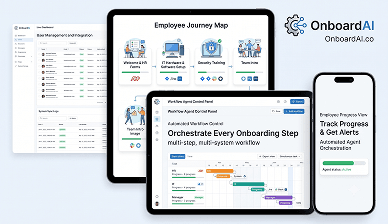
An agent that orchestrates multi-step, multi-system employee onboarding — accounts, access, equipment, paperwork — and chases what has not happened yet.
At a glance
- Duration
- 17 weeks
- Team size
- 1 person
- Engagement
- New build
- Project type
- AI & automation
- Industry
- B2B SaaS
Built with
The situation
The challenge
Onboarding is a dependency graph across systems that do not talk to each other, and the failure mode is silent: a step nobody completed, noticed on the new hire's first morning.
What we did
Model onboarding as a state machine with owners and deadlines per step, and make the agent responsible for chasing rather than for deciding.
The calls that mattered
Explicit state per step, not a checklist
Each step has an owner, a deadline and a state. A checklist tells you what should happen; a state machine tells you what has not.
Escalation is the default outcome
Anything incomplete escalates on a schedule rather than waiting to be discovered.
What changed
- coordinator time saved per hire
- 12hrscoordinator time saved per hire
- silent failures
- 0silent failures
- 0 — every incomplete step escalates
Roughly twelve coordinator hours saved per hire, with nothing incomplete going unnoticed.
Services used
- Onboarding state machine across HR, IT and access systems
- Ownership, deadline and escalation model
- Coordinator dashboard
What we would do differently
Every project has one of these. Publishing it is the point — a case study with no regrets in it is marketing, not evidence.
The orchestration mattered more than the intelligence. Most of the value came from modelling the process properly, and only a little from anything the model contributed.
More work
- Internet Money · Crypto financial services$10M+monthly transaction volume
One wallet interface across five blockchains
A multi-chain crypto platform where every chain hides behind one interface, with a tamper-evident audit trail underneath it. $10M+ moves through it monthly.
Read case study - MagicTask · Project management SaaS100K+concurrent users
From latency spikes at 5,000 users to 100,000 concurrent
A gamified project management platform re-architected from a single Node server into an event-driven system that holds 100,000+ concurrent connections without the reward engine touching the critical path.
Read case study